
Point-to-point integrations
Every new application adds fragile links that nobody controls any more.
EXPERTISE · INTEGRATION & ORCHESTRATION
API management, enterprise service buses, event-driven messaging and process automation: we connect your applications, your partners and your processes.
WHY IT’S CRITICAL
Your core system speaks its own language. Outside, instant payments speak ISO 20022, fintechs speak REST, and your customers speak mobile. We design the layer that translates, orchestrates and protects, without replacing what works.
We have done it for BCEAO interoperability, for mediation buses in production at operators, and for banking process automation.
THE CHALLENGES
Every new application adds fragile links that nobody controls any more.
Without control over access, quotas and usage, every API becomes an open door.
Opening an account takes three days and five signatures: the process is holding back digitalisation.
WHAT WE DO
Services that combine to fit your context, from scoping to operations.
Developer portal, sandbox, quotas and security for APIs exposed to partners and fintechs.
Orchestration of critical transaction flows between applications.
Systems publish events and react in real time.
Model and execute business workflows end to end.
Internal flows, notifications, file exchanges, without heavy development.
Connection to interoperability systems and instant payments.
OUR APPROACH
Applications, partners, existing flows and weak points.
Flow mapFormats, security, volumes and commitments for each interface.
Interface contractsConnectors, APIs, processes, end-to-end testing.
Flows in productionExchange tracking, alerts, scaling.
Tracking dashboardsWHAT YOU GET
Scope, responsibilities and acceptance criteria are defined during scoping.
Flow mapAnd documented interface contracts.
Connectors, APIs and processesDelivered, tested and put into production.
Exchange tracking dashboardsVolumes, errors, lead times.
Recovery proceduresTo handle flow incidents.
REFERENCES
BNI · CÔTE D’IVOIRE
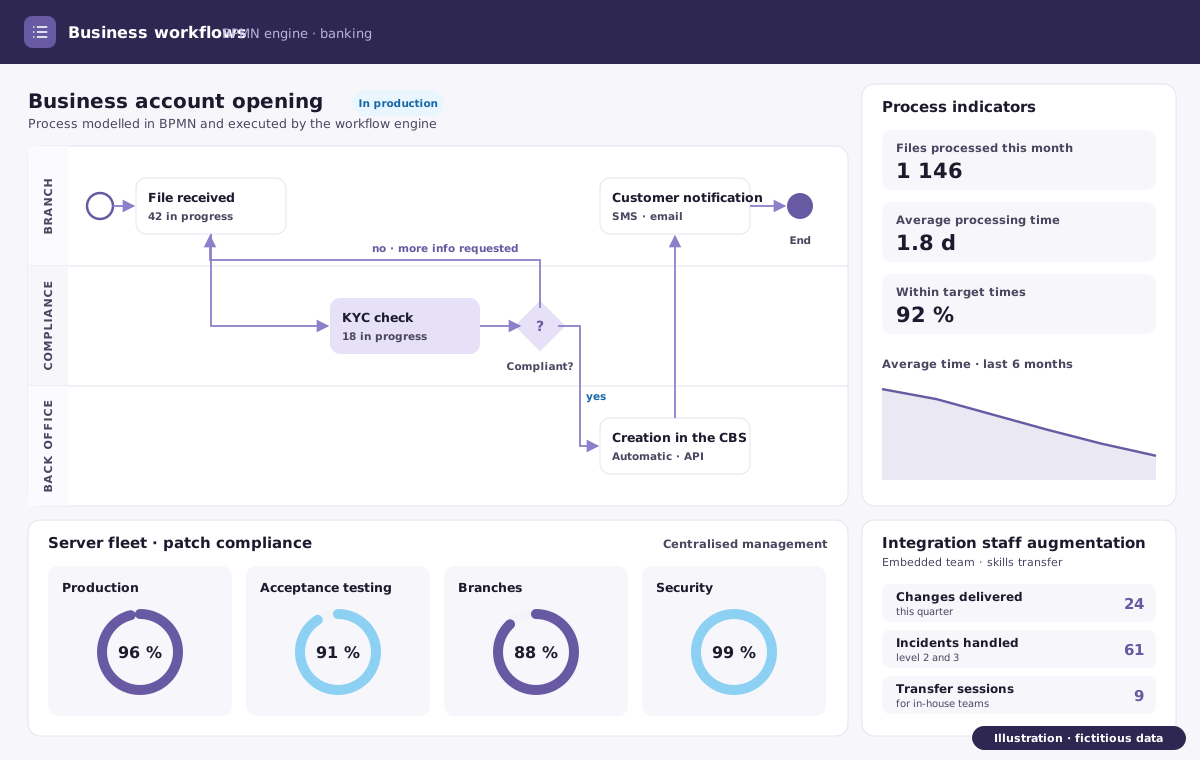
A BPMN engine to automate business processes and cut processing times, with an embedded integration staff augmentation team.
Read the case study →Full integration with the Central Bank’s interoperability system (AIP).
An orchestration ESB for fixed-line and data services, and a redesign of production workflows.
A foreign exchange platform connected to several banks.
Expertise involved →TECHNICAL ENVIRONMENT
Around thirty open-source and vendor solutions, chosen to fit your context. Technologies are confirmed during scoping.
FREQUENTLY ASKED QUESTIONS
Rarely. The integration layer opens up the core system without replacing it: it keeps doing what it does well, and the middleware handles the rest.
Both have their place: an ESB or integration microservices for critical transaction flows, and tools such as n8n for less critical internal orchestration.
We use software robots (RPA) as a temporary bridge while the application is modernised.
GO FURTHER
GETTING STARTED
WHEN TO CALL US
Fragile exchanges between applications, partners to connect, an interoperability project.
FIRST ENGAGEMENT
A critical flow assessment: mapping, failure points and integration target.
INDICATIVE DURATION
3 to 4 weeks
WHAT WE NEED FROM YOU
Existing interfaces, one contact per application and access to logs.